Why Intellectual Honesty Matters More Than Marketing Claims
In online language learning, companies routinely claim that every detail of their platform is backed by hundreds of peer-reviewed papers. The reality of cognitive linguistics is far more nuanced: research findings frequently conflict with one another. A technique that maximizes test scores on a multiple-choice grammar exam can completely derail spontaneous speaking inside a busy restaurant or train station.
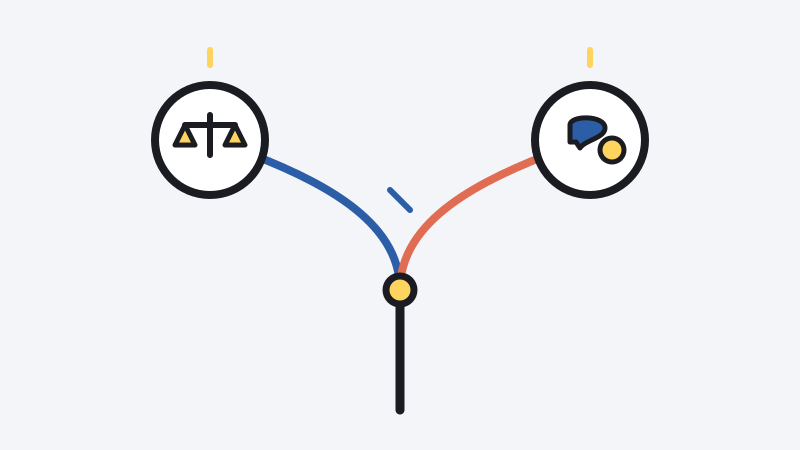
When designing Lexy, we grounded our curriculum in Second Language Acquisition (SLA) science. Yet in three decisive areas, we made a conscious choice to break away from traditional academic recommendations. Here is an honest breakdown of the research we diverge from, why we made those choices, and the specific pedagogical trade-offs involved.
1. Immediate Error Correction: Li (2010) Meta-Analysis
Mainstream language teaching methodology holds a firm consensus: instructors must promptly correct student errors. Shaofeng Li's 2010 meta-analysis in Language Learning (33 studies, N = 1,973, DOI 10.1111/j.1467-9922.2010.00561.x) found a solid medium effect size for corrective feedback: d = 0.64. A companion meta-analysis by Lyster & Saito (2010, 15 studies, DOI 10.1017/S0272263109990520) reported an even higher effect size: d = 0.74. The standard pedagogical conclusion is clear: mistakes must be interrupted immediately to prevent fossilization in long-term memory.
What Lexy does differently: throughout the first 15 lessons of the course, Lexy does not correct spoken mistakes during live conversation. Zero interruptions, zero grammatical remarks, zero mid-sentence corrections from the AI avatar. Error breakdown is separated into a dedicated review step after the dialogue concludes.
Why we chose this trade-off: laboratory meta-analyses measure linguistic accuracy under artificial test constraints. They completely ignore the emotional reality of an adult beginner. The seminal work on Foreign Language Classroom Anxiety by Horwitz, Horwitz & Cope (1986, DOI 10.1111/j.1540-4781.1986.tb05256.x) established that the constant fear of instructor correction is the primary driver of communicative freezing. Immediate corrections trigger Krashen's affective filter (1982), disrupt speech rhythm, and cause adult learners to shut down. In lessons 1 to 15, our single priority is breaking the psychological barrier. We deliberately trade away immediate formal accuracy to build spoken fluency first.
2. Word-Level Tap Translation: Nation (2001) and Hulstijn (2001)
Extensive research into second language vocabulary acquisition (Paul Nation, 2001, DOI 10.1017/CBO9781139524759; Jan Hulstijn, 2001) highlights the utility of word-level glossing. Providing instant clickable word definitions reduces reading difficulty and accelerates passive vocabulary growth. Almost every commercial language app relies on this mechanism: tap any single word to reveal its isolated translation.
What Lexy does differently: in Lexy, learners cannot click individual words during a speaking session. You can only translate an entire sentence or replay the complete sentence at a slower pace.
Why we chose this trade-off: word-by-word glossing conditions the learner's brain to translate sequentially through their native language. Natural conversation operates very differently. Landmark research into formulaic language (Alison Wray, 2002, DOI 10.1017/CBO9780511519772; Pawley & Syder, 1983) demonstrates that native-like fluency relies on pre-assembled multi-word lexical chunks and collocations, not on assembling isolated vocabulary items on the fly. When learners dissect each sentence word by word, response latency stretches to several seconds. Lexy compels working memory to treat the entire utterance as a single communicative unit.
3. The Classic IRF Classroom Dialogue Cycle: Sinclair & Coulthard (1975)
Over ninety percent of language classrooms and chatbot interactions follow the classic IRF triad (Initiation, Response, Feedback) documented by Sinclair & Coulthard (1975) and Mehan (1979). The teacher initiates with a question, the student responds, and the teacher evaluates the answer before introducing the next query. Mainstream language bots replicate this interrogation model: the bot questions, the student passively replies.
What Lexy does differently: every micro-dialogue in Lexy adheres to a four-step sequence. The avatar asks a question, the learner speaks their answer, and on step three, the learner must independently ask a reciprocal question aloud before the avatar answers in character.
Why we chose this trade-off: real conversations abroad are not interviews. In a café, at customs, or in a hotel, learners must initiate interactions and frame questions themselves. Research on conversational autonomy (Leo van Lier, 1996; Celeste Kinginger, 2008) reveals that students trained exclusively in teacher-fronted IRF routines freeze when visiting target-language countries because they never practiced framing interrogative structures under speaking pressure. Requiring reciprocal questions breaks passive habits and builds true conversational agency.
Summary Table: Academic Consensus vs Lexy Design
| Learning Dimension | Standard Academic Consensus | Lexy Implementation | Deliberate Trade-Off |
|---|---|---|---|
| Error Correction | Immediate correction to prevent fossilization (d = 0.64; Li, 2010) | Lessons 1–15 without mid-speech critique; post-lesson review | Sacrificing immediate formal precision to dismantle speaking anxiety (FLCAS) |
| Vocabulary Parsing | Word-level tap translations for lower friction (Nation, 2001) | Full-sentence translation and slow audio only | Fostering multi-word formulaic chunks (Wray, 2002) over mental literal translation |
| Dialogue Dynamics | Teacher-led IRF questioning loop (Sinclair & Coulthard, 1975) | Compulsory learner-initiated reciprocal question on every slide | Instilling conversational initiative rather than passive compliance |
Methodology as an Architecture of Balanced Constraints
Effective pedagogy is never about blindly implementing every isolated research finding. It is about reconciling conflicting cognitive demands. We also reject the popular "5 minutes a day" marketing trope: five minutes is insufficient for the brain to warm up and engage motor speech circuits. A complete 25-minute lesson with Lexy guides the student through seven connected stages: 1. Vocabulary (flashcards and matching quiz), 2. Warm-up (short written chat), 3. Lesson (25-minute live voice dialogue with the avatar without typing), 4. Exercises (keyboard-based grammar tasks, listening, and tests for cognitive decompression), 5. Dialogue (two-voice situational listening), 6. Story (reading story with sentence breakdown), and 7. Memory Flashcards (spaced repetition of the prior lesson from lesson 2 onward). Spoken conversation is deliberately paired with quieter exercises to prevent vocal fatigue.
Knowing what we intentionally opted out of empowers students to practice with purpose: letting go of the expectation of constant correction in the early weeks, listening in whole sentences, and taking the initiative in conversations from day one.
Key Takeaways
- SLA research literature contains genuine trade-offs: optimizing for grammar test accuracy directly conflicts with lowering speaking inhibition.
- Lexy delays error correction until after the lesson in stages 1–15, prioritizing fluency over immediate formal accuracy to protect against foreign language anxiety (Horwitz et al., 1986).
- Disallowing single-word translations breaks the habit of literal mental translation and develops formulaic sequences (Wray, 2002).
- Mandatory reciprocal questions disrupt passive classroom IRF dynamics, training students to initiate conversations in the real world.
Key Takeaways on Lexy Methodological Trade-Offs
- We intentionally delay error correction in lessons 1–15 to prioritize speaking fluency over immediate grammatical accuracy.
- Whole-sentence translations teach learners to process formulaic language chunks instead of translating individual words.
- Mandatory reciprocal questions turn learners into active conversational leaders rather than passive respondents.
Test Your Knowledge: Article Quiz
90-second quiz: check whether you understood the key themes of this article. 5 quick questions. If you make a mistake, we explain it right away.
Experience Evidence-Based Speaking Practice
Try a 25-minute speaking lesson with Lexy for free. Real conversation without the fear of criticism across 49 supported languages.
Start Free Lesson →