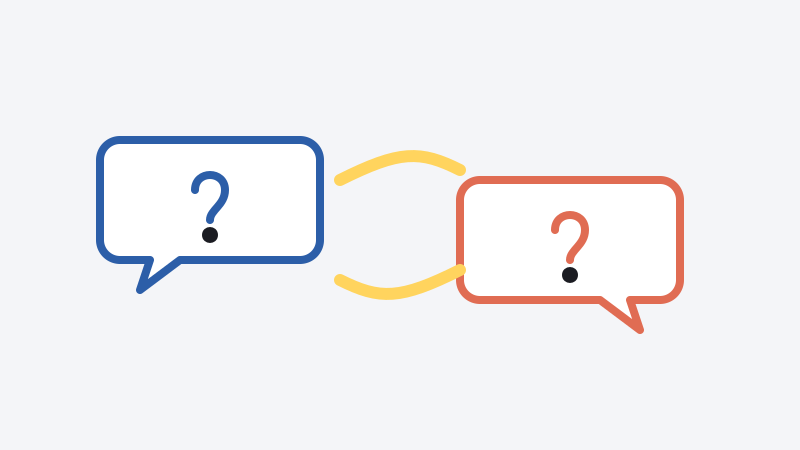
A familiar dilemma plagues language graduates: abroad, they can answer basic questions, yet the conversation stalls within 30 seconds. This failure stems from conventional teaching methods that reduce dialogue to one-sided interrogation.
The Dynamics of Turn-Taking
In their foundational Conversation Analysis work, Harvey Sacks and Emanuel Schegloff established that authentic communication depends on bidirectional turn-taking. Conversation is mutual navigation rather than isolated reactive answers.
In standard tutoring or quiz apps, the student occupies a permanently subordinate answering position. Consequently, the neural pathways responsible for discourse initiation remain dormant.
The Power of Reciprocal Questioning
Professor Alison King proved that training students to formulate reciprocal questions doubles processing depth and accelerates fluency compared to passive answering.
Without practice in seizing conversational agency, learners suffer constant anxiety, passively bracing for the interlocutor’s next query.
Lexy’s Counter-Question Protocol: [slide_asked_back]
Lexy directly operationalizes this sociolinguistic necessity through the [slide_asked_back] tag.
- Bidirectional interaction: on each dialogue step, the learner not only responds to the avatar but must ask a relevant counter-question.
- Automated transitions: phrases like "And what about you?", "Where can I find...?" become second nature.
- True conversational parity: in real-world interactions, learners comfortably pilot the discussion rather than feeling interrogated.
Key Takeaways: Reciprocal Questioning
- Being trapped in a passive respondent role prevents learners from sustaining genuine dialogue.
- Reciprocal questioning doubles linguistic processing and eliminates awkward conversational silence.
- Lexy requires students to ask counter-questions on every slide, cultivating true social fluency.
Test Your Knowledge: Article Quiz
90-second quiz: check whether you understood the key themes of this article. 5 quick questions. If you make a mistake, we explain it right away.
Lead Conversations as an Equal
Practice spontaneous bidirectional dialogue with Lexy’s conversational avatar today.
Start Free Lesson →